What can two cities shaped by empire teach a generation of African curators about building cultural infrastructure at home — and what do they bring back that reshapes the conversation in return?
From 12 to 24 May 2026, the Art Exchange: Moving Image cohort travelled from six countries across Sub-Saharan Africa to Liverpool and London for an intensive residency supported by the British Council. Designed for emerging and mid-career curators, the programme offered a shared passage through exhibitions, collections, artist studios and archives, where the moving image was encountered not as a fixed medium but as an interdisciplinary approach shaped by multiple temporalities.
Across two weeks, the residency unfolded as a series of encounters that built upon one another. Conversations with artists, curators, researchers, and cultural practitioners working across exhibition-making, residencies, collections, and conservation opened up critical dialogue not only about artistic practice but also about the infrastructures that sustain it.
Starting in Liverpool, visits to the Walker Art Gallery, FACT, Tate Liverpool, Bluecoat, Open Eye Gallery, and the Exhibition Research Lab at the University of Liverpool offered distinct but related perspectives on how historical and contemporary art is critically engaged. The city itself, shaped by its colonial trade routes and contemporary cultural renewal, remained a constant backdrop, quietly informing discussions of memory, representation, and the politics of display.
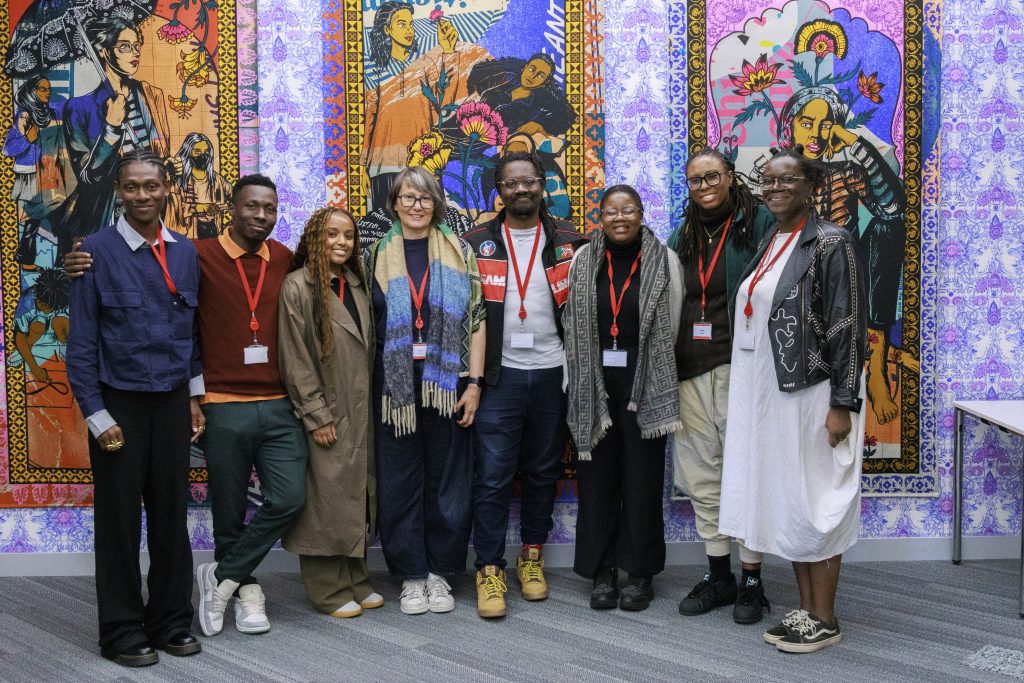
Art Exchange: Moving Image Programme cohort visits the British Council headquarters, London. Image credit: Sarah Ejionye-Adigwe, 2026.
Left to right: Menenaba, Kajebe Jacob Joshua, Abigail Megbar Debebe, Erika Tan, Larry Achiampong, Azola Krweqe, Seju Alero Mike, Awuor Onyango.
A key moment came with the opening of John Akomfrah: Listening All Night to the Rain at the Walker Art Gallery. Following its presentation at the British Pavilion at the 2024 Venice Biennale, the exhibition brought the cohort into Akomfrah’s immersive moving-image practice. In conversation with the artist, discussions extended to broader questions of how images carry history and how they speak to contemporary urgencies without relinquishing complexity.
Later, at Exhibition Research Lab, Co-Director Christine Eyene led a walkthrough of the exhibition George Hallett: Home and Exile. Through Eyene’s insights, participants explored Hallett’s photographic archive and reflected on questions of diaspora, liberation, identity, and the preservation of African visual histories.
The visit continued at Bluecoat, UK’s first arts centre and the oldest building in the city centre, where Steve McQueen’s newly commissioned work, Grenfell, was screened. The work’s restrained structure held space for reflection on loss, remembrance and accountability. Rather than resolving into narrative closure, it invited sustained attention, prompting discussions among the cohort about the role of moving image as a form of public witnessing and shared memory.
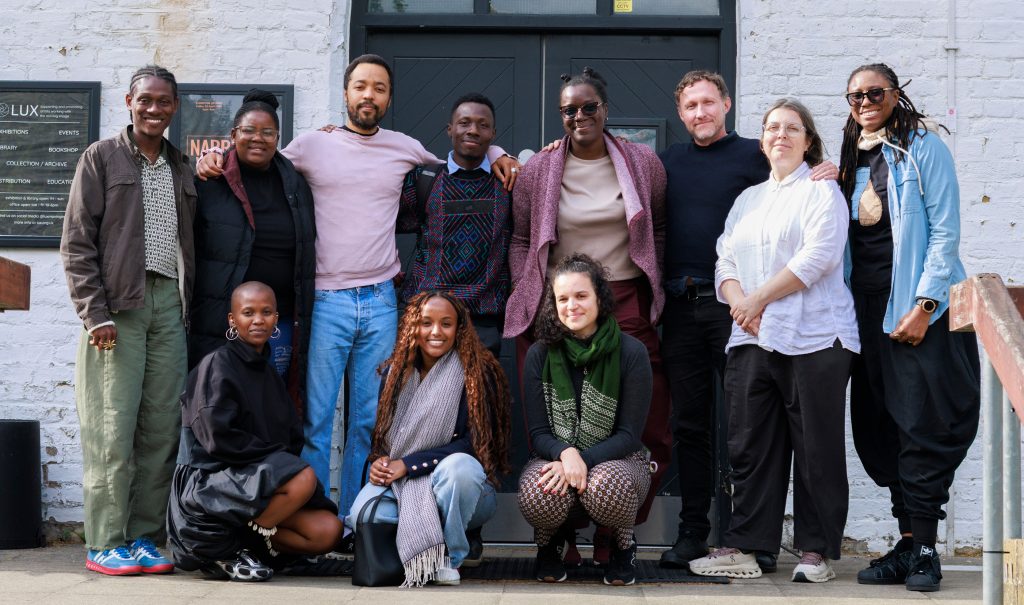
Art Exchange: Moving Image Programme cohort visiting LUX Moving Image, London. Image credit: Sarah Ejionye-Adigwe, 2026.
Back row (left to right): Menenaba, Azola Krweqe, Morgan Quaintance, Kajebe Jacob Joshua, Awuor Onyango, Benjamin Cook, Ali Roche, Seju Alero Mike. Front row (left to right): Kefiloe Siwisa, Abigail Megbar Debebe, Leah McGurk.
As the residency moved to London, the tempo shifted, but the sense of continuity remained. If Liverpool foregrounded memory, place and history, London further opened up conversations about the systems that enable moving-image practices to circulate, develop and endure. Visits to LUX Moving Image, Institute of International Visual Art (Iniva), the British Film Institute (BFI), V&A East, V&A Storehouse, Forma, Gasworks, the Institute of Contemporary Arts (ICA), the British Council Collection and the Africa Centre revealed how London’s rich ecology of cultural institutions is pushing new boundaries.
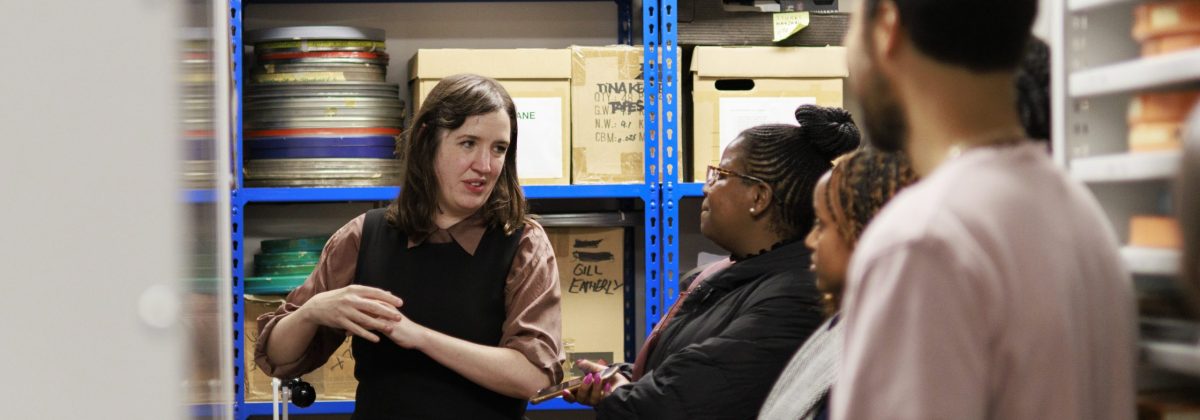
At V&A East, The Music Is Black: A British Story traced the influence of Black British music on cultural and social transformation, offering a compelling lens through which to consider how music shapes society. Meanwhile, visits to the V&A Storehouse and the BFI made visible the scale of work involved in conserving time-based media. From storage systems to cataloguing processes and preservation strategies, these encounters underscored how cultural memory is actively maintained, and continually negotiated, within institutional frameworks.
The British Council Collection introduced another dimension to the residency, pointing towards its next phase. Here, curators learned how they will develop exhibitions in their home countries using works from the collection. Discussions centred on how artworks shift meaning across contexts, and how curatorial practice becomes a form of translation between institutions, audiences and local realities.
This sense of translation continued at Gasworks, where the cohort met artists in residence, a visit that offered practical insight on how institutions can support artists over time, not only through exhibition opportunities but by creating the conditions for long-term artistic development.
A visit to Larry Achiampong’s studio brought these ideas into closer proximity. Away from institutional spaces, the cohort encountered a practice shaped by research and experimentation. Moving between sound, moving image, installation, photography and digital technologies, Achiampong’s work revealed how his practice finds form through multiple forms of making and collaboration. The studio offered a different register of understanding, grounded in process rather than presentation, where ideas are continually tested, adjusted and reimagined.
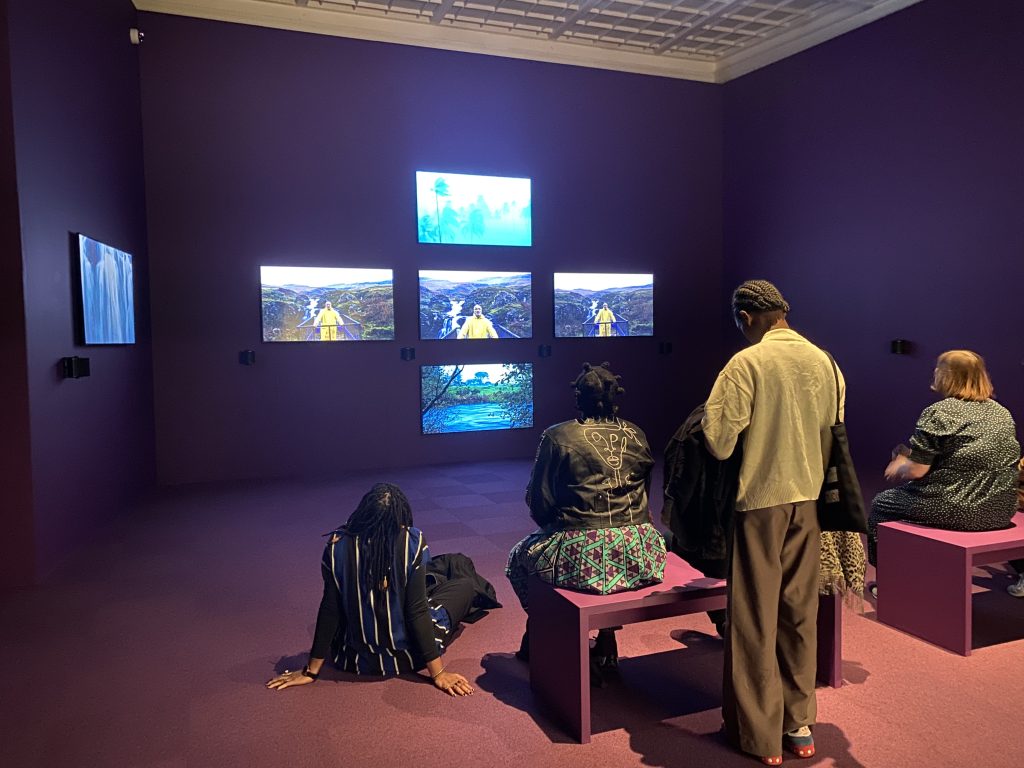
Art Exchange: Moving Image Programme cohort visits Sir John Akomfrah’s exhibition, Listening All Night to the Rain, at the Walker Art Gallery, Liverpool. Image credit: Eben Keun, 2026.
Within the cohort itself, meaning was equally shaped through exchange. As curators from diverse backgrounds, they shared experiences, compared working contexts and reflected on the different conditions shaping moving image and their wider practice across Sub-Saharan Africa and beyond. Over time, understanding deepened not only through formal sessions but also through the accumulation of conversations between visits, where ideas were tested, challenged, and refined.
Kajebe Jacob Joshua reflected on this process of movement, noting both the specificity of the UK’s art ecosystem and the way curatorial thinking is shaped through sustained engagement with different institutional contexts. Moving through diverse institutional structures highlighted how practice is formed in relation to systems rather than in isolation, shaped by ongoing dialogue between geography, infrastructure and curatorial intent.
Generosity ran quietly through the residency, shaping how participants moved through both cities. As one participant reflected, “It was fantastic to learn about London’s art ecosystem and to feel encouraged by the community.” This openness was not incidental but formative, allowing participants to engage with institutions as spaces of exchange rather than observation.
Beyond the formal programme, the residency extended into informal spaces that proved equally generative. Participants used their free time to revisit exhibitions, meet artists and curators, and deepen relationships from existing networks. These moments did not sit apart from the programme but folded back into it, often reframing earlier encounters and drawing unexpected connections between ideas and practices.
For Awuor Onyango, the residency was defined by “expansion and possibility.” Reflecting on the journey, she described being given “a front-row seat to the infrastructures of care, distribution, dissemination and artistic support being built across London, Accra, Durban, Addis Ababa, Lagos and Kampala.” Within this wider field, she noted that the experience sharpened a clearer sense of “what remains possible for us to build at home,” a reflection shaped through the movement across spaces.
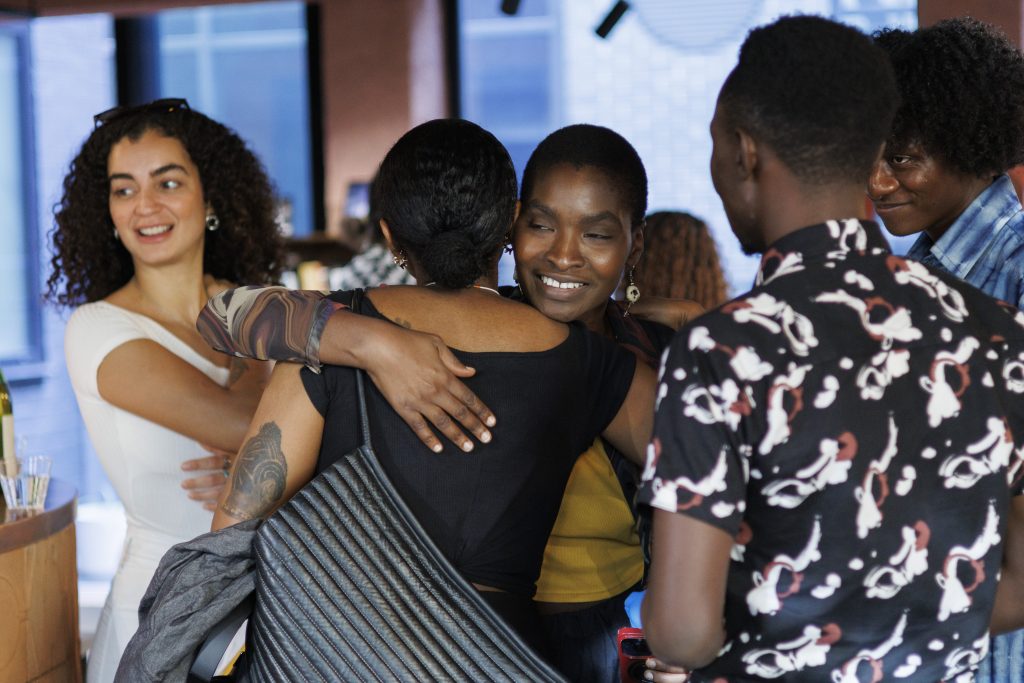
Art Exchange: Moving Image Programme networking event at Africa Centre, London. Image credit: Sarah Ejionye-Adigwe, 2026.
By the end of the residency, what unfolded across Liverpool and London had begun to settle into a more coherent sense of practice and possibility. The cohort left with new ideas, expanded networks and an expansive perspective on moving image practices and cultural production.
More than a study visit, the residency functioned as a point of departure, opening up ways of thinking about how curatorial and institutional support might be shaped differently within their own contexts.
Art Exchange: Moving Image is a cross-cultural curatorial professional development and exhibition programme for early to mid-career visual arts curators from Sub-Saharan Africa and South Asia, taking place from 2023 to 2027. Find out more at artexchangemovingimage.uk