This is an extract of a short story written in response to an image from the Hidden Years Music Archive for the multimedia exhibition, ‘Decay without mourning: Future thinking heritage practices’. The full story will eventually be published in an anthology as part of the project.
by David Mann
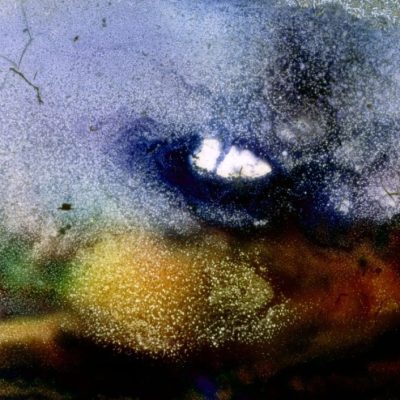
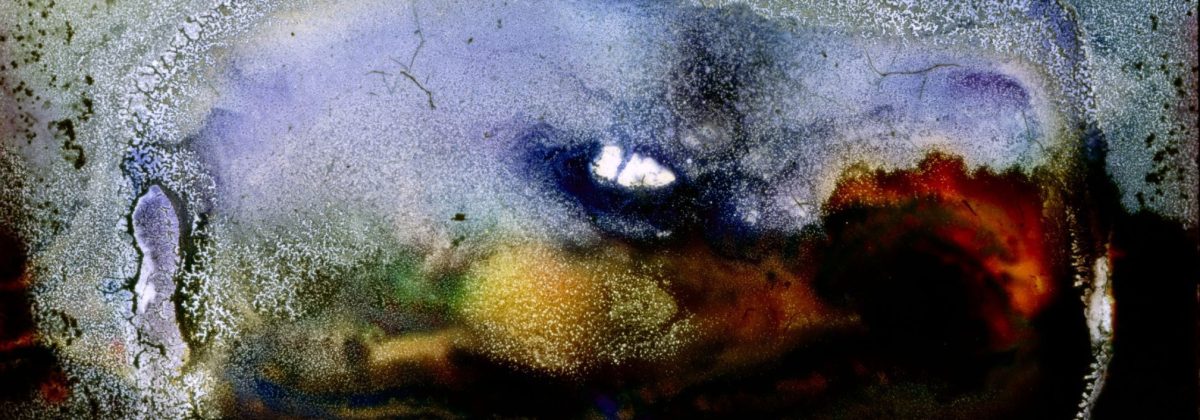
The soiled photograph is what grabs Zahra’s attention. She’s seen so many items just like it over the last few days – waterlogged, moulded, corrupted – but there’s something about this image, it’s garish colours and inviting composition, that stirs something in her. She likes that she can’t tell what’s in the photograph, exactly. Hundreds of potential images present themselves to her. Inks rupture and bleed into one another, pooling. Speckled yellow, clotted red, and pale green and blue are framed by a galaxy of mould spores. The image, whatever it is, was ruined long before the fire. Now, it’s become something else. She slips it into a plastic sleeve, and then, on impulse, into her bag.
They are working out of one of the few parts of the Johannesburg Art Gallery that’s still standing, a cramped room off the West wing of the building. She works with a face-mask on, which helps against the fine layer of ash covering everything, but doesn’t do much for the smell of smouldering plastic and charred wood that hangs in the air. Town is noisy, full of the hoot and blare of taxis, the hoarse calls of men. Potholes mark the roads and scrap fires burn along the pavements. It’s been like this for as long as Zahra can remember.
Two weeks ago, a fire broke out in one of the basement storage rooms of the gallery. They still don’t know what caused it, only that the first signs of smoke would have shown around midnight, and the low glow of flames shortly after that. The fire trucks arrived around 6am, when the fire had already spread and gutted most of the rooms on the ground floor.
Zahra’s part of a small team of public and private museum employees, mostly from the Ditsong museums, who’ve been brought in by Friends of the JAG to save what remains. Truthfully, it’s an exercise in tallying the dead. The JAG, once an oasis in the city, though always in some state of infrastructural decline, had started to crumble in earnest about a decade ago. But the rot was internal, too: missing artworks, mismanaged funds, overblown pay checks – it had become a site of ethical, cultural deterioration.
They’ve set up a temporary office for their rescue mission – dutifully cataloguing the salvaged artworks from the collection. It’s a far cry from the administrative work she does at the Joburg Contemporary Art Foundation, but she is passionate about the JAG – she wrote her Masters thesis on the collection – and her job is part-time in any case. She can afford to spend a few days a week sifting through the detritus of the building. Truthfully, this kind of hands-on work makes her feel as if she’s earned the title “cultural worker”. She presses on.
Most of the sculptures are relatively unscathed. They’re stubborn things, she thinks, made to outlive the ages they were created in. Some, with their rusted patinas, even look improved. It’s a different story for the prints, paintings, and photographs. So many of them lost to the fire. The few that remain are sodden or stained.
Yesterday, she spent the afternoon sifting through the charred remains of David Goldblatt’s photographic series The Transported of KwaNdebele. The images were taken on a bus transporting workers from their homes in Marabastad to work in Pretoria in the early hours of the morning. In one of the burned photographs, a surprising amount of the original image remained, preserved behind a shard of broken glass from the frame. In this sliver of image, there was a person wearing a white beanie wrapped up in a checkered blanket and seated, with their knees pulled up to their chest. Surrounded by burned and blackened edges and divorced from its original composition, the image had a new story, she thought. The bus had broken down, burned out, the commute indefinitely postponed. What good was a job when everything was in ashes?
But they’ve only been given a week to make their way through the mess and so there is little time to linger on the works. She simply placed the image and its glass shard into a plastic sleeve, located the work on her laptop, and wrote down the corresponding set of letters and numbers in blue marker on the front of the plastic sleeve.
Today, she’s been making her way through a collection of water damaged drawings by the French sculptor, Aristide Maillol. It’s a set of female nudes, all seemingly of the same woman and all done in red pencil which has now bled and soaked into the page, blurring the deliberate lines of the drawings. Zahra consults the drawings on her laptop and sees a woman without much expression in her face, pulling her hair back over her shoulders, away from her face. She looks down at the drawing in her hand and what she sees is a woman with a pained expression pulling out her hair, standing on swollen, bleeding feet. Funny, she thinks, how objects compel you to make meaning, find narrative in them, even in their tarnished states.
Still, she cannot stop thinking of the image in her bag. Why was she compelled to take it? It’s nothing but a moulded old photograph, destined to be discarded. Unlike almost everything else in the JAG, though, it seems to be charged with life – those fluorescent hues and swirling forms. It’s an image she wants to fall into, rediscover. Is it an afterlife, perhaps? A dead photograph that, in its decaying state, invites new meaning, different stories? Back home, she thinks, she will be able to do some proper research.